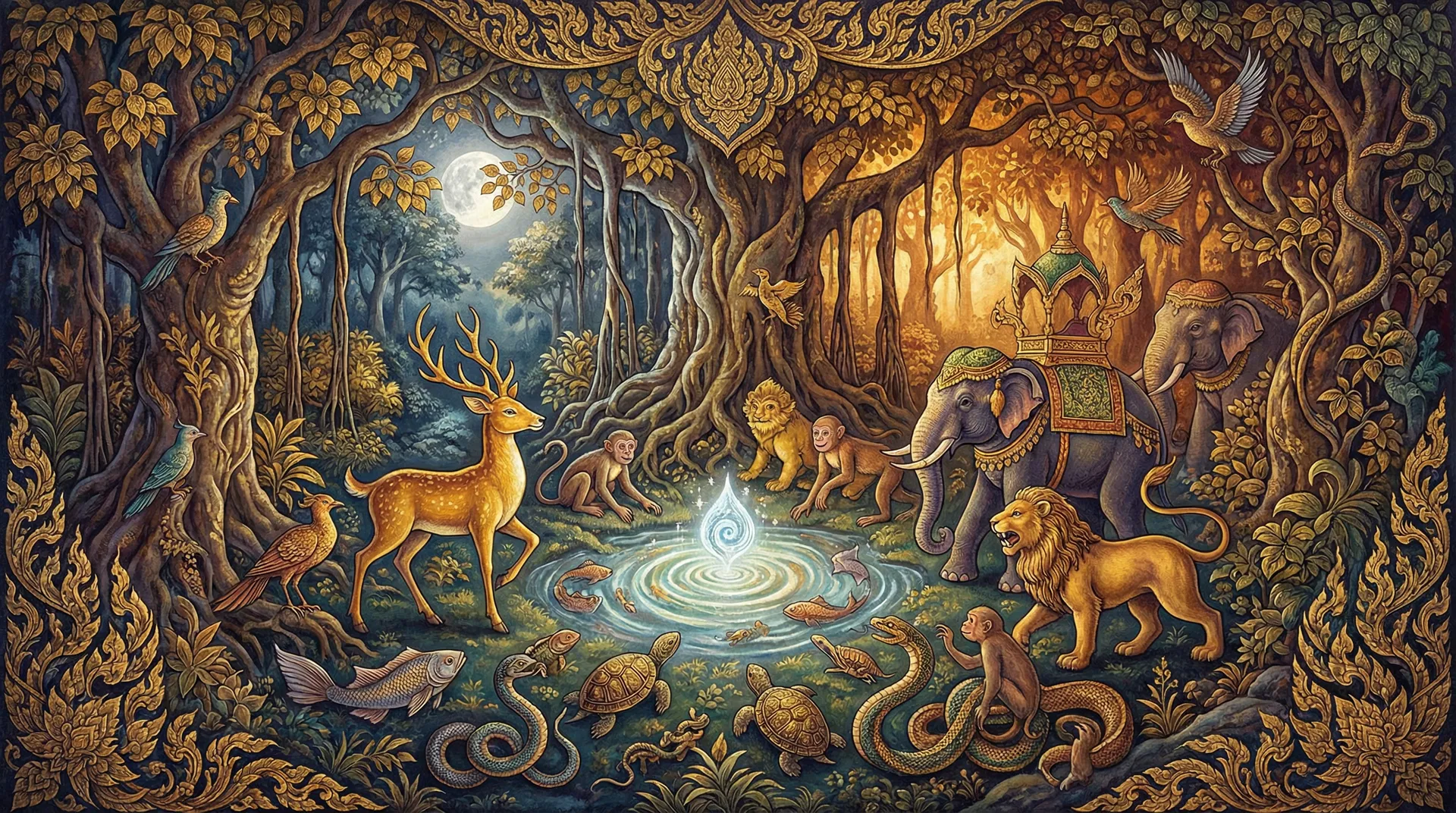
Temiya Jataka
Temiya Jataka
In the opulent city of Ujjeni, reigned King Kalabu, a monarch whose heart was as cold as the winter winds and whose reign was marked by tyranny and cruelty. His subjects lived in constant fear, their lives dictated by the king's whims and his insatiable hunger for power. Among his many palaces and vast riches, lived Prince Temiya, the king's son, a being of profound spiritual depth, destined for greatness, though his path would be unconventional.
From the moment of his birth, Prince Temiya displayed an unusual detachment from the world. While other children clamored for toys and attention, Prince Temiya remained serene and introspective. He seemed to possess an innate understanding of the impermanence of life and the futility of worldly pursuits. This profound awareness, which manifested as an almost complete lack of interest in worldly affairs, troubled his parents, King Kalabu and Queen Pancala.
As Prince Temiya grew older, his disinterest intensified. He showed no inclination towards warfare, governance, or the pleasures of the court. He would spend hours in silent contemplation, his gaze distant, as if observing realms beyond human comprehension. His parents, desperate to awaken in him a sense of princely duty and worldly ambition, tried every means to stir his spirit. They presented him with exotic gifts, luxurious garments, and the finest entertainment, but Prince Temiya remained unmoved.
King Kalabu, a man who valued strength and power above all else, grew increasingly frustrated. He saw his son's passivity as a weakness, a disgrace to the royal lineage. He ordered that Prince Temiya be subjected to various trials, hoping to break his spirit and force him to embrace his royal destiny. These trials were often cruel and designed to instill fear, but Prince Temiya endured them all with the same unwavering equanimity.
One of the most harrowing trials Prince Temiya endured was being placed in a coffin and buried alive. The king, in his misguided attempt to shock his son into action, believed that this would surely awaken him to the harsh realities of life and death. As the earth was shoveled over the coffin, Prince Temiya remained calm, his mind focused on the impermanence of the physical body and the enduring nature of the spirit. He saw this not as punishment, but as another lesson in detachment and the understanding of suffering.
Upon his 'resurrection,' Prince Temiya’s detachment only deepened. He had witnessed the abyss of death and found no fear, only a profound understanding of the cycle of existence. His parents, bewildered and despairing, finally sought the counsel of wise hermits and learned scholars. They explained that their son was not suffering from a lack of spirit, but from an abundance of spiritual wisdom. They revealed that Prince Temiya was a Bodhisattva, a being who had attained such a high level of spiritual development that he had seen through the illusions of worldly life.
The sages explained that Prince Temiya’s apparent apathy was, in fact, his profound understanding of the suffering inherent in existence. He recognized that the pursuit of power, wealth, and pleasure only led to further entanglement in the cycle of birth and death, a cycle he was determined to transcend. His goal was not to rule a kingdom, but to attain liberation from all forms of suffering.
Understanding this, King Kalabu and Queen Pancala, though still saddened, began to comprehend their son's true nature. They realized that forcing him to conform to their worldly expectations would be a disservice to his spiritual calling. They decided to allow Prince Temiya to follow his own path, a path that led away from the throne and towards the higher realms of spiritual attainment.
Prince Temiya, finally free from the expectations of his royal lineage, left the palace. He did not seek worldly fame or power, but dedicated himself entirely to spiritual practice. He embraced a life of austerity, meditation, and deep contemplation, his sole aim being to achieve enlightenment for the benefit of all beings. He understood that true kingship lay not in ruling over a kingdom of men, but in mastering the kingdom of the mind.
His journey was one of profound inner transformation, a testament to the fact that the greatest battles are fought within the heart and mind. Prince Temiya's story became a legend, inspiring countless individuals to look beyond the superficiality of worldly pursuits and to seek the enduring peace and wisdom that comes from spiritual awakening. He demonstrated that true renunciation is not an act of weakness, but an act of immense strength and profound understanding.
The greatest battles are fought within the heart and mind. True renunciation is not an act of weakness, but an act of immense strength and profound understanding.
— In-Article Ad —
💡Moral of the Story
True spiritual understanding leads to detachment from worldly pursuits, and true liberation comes from mastering the mind.
Perfection: Renunciation (Nekkhamma Paramita)
— Ad Space (728x90) —
More Jataka Tales You May Enjoy
 92Ekanipāta
Sasa Jataka
Sasa JatakaLong, long ago, in a time when the forests were vaster and the stars shone brighter, ther...
💡 True generosity lies not in giving what is easily spared, but in sacrificing one's own comfort and even life for the sake of others. Selflessness and compassion are the highest virtues.
 293Tikanipāta
Macchusaṇḍa Jātaka
The Tale of the Fish Who Saved a CityIn the ancient city of Kosala, nestled beside the vast and shim...
💡 Respect for nature and its creatures is paramount. True prosperity comes from living in harmony with the environment, not from exploiting it. Sincerity and humility can move even the most powerful forces.
 160Dukanipāta
Rohana Jataka
Rohana JatakaIn the ancient city of Ujjeni, a hub of trade and culture, lived a wealthy merchant nam...
💡 True wealth lies not in hoarding material possessions, but in sharing them to alleviate the suffering of others.
1EkanipātaThe Tale of the Great Lotus
The Tale of the Great Lotus In a time long past, when the world was a canvas of verdant forests and...
💡 Impatience is like a fire that burns everything, but wisdom and concentration are the tools that allow us to control situations and achieve goals with stability.
27EkanipātaThe Bodhisatta as a Deer King
The Bodhisatta as a Deer KingIn the heart of a verdant forest, where ancient trees stood sentinel an...
💡 True courage and leadership are demonstrated through selfless sacrifice for the well-being of others.
15EkanipātaThe Bodhisatta as a Scholar
The Bodhisatta as a ScholarIn the hallowed halls of an ancient monastery, nestled amidst serene, rol...
💡 True wisdom is demonstrated through the compassionate application of knowledge for the well-being of others.
— Multiplex Ad —